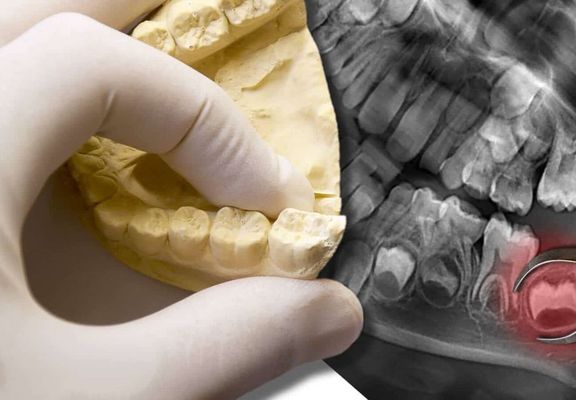
Wisdom teeth do not always need to be removed. If there is enough space in the jaw, proper alignment with the opposing teeth, and no signs of gum disease, the teeth can safely remain. However, when wisdom teeth are positioned at an angle, early treatment is recommended to prevent damage to the roots of neighbouring teeth. Partially erupted wisdom teeth are particularly problematic from a hygiene standpoint, as they are difficult to clean and can hinder effective brushing of adjacent teeth. When wisdom teeth lie deep within the jawbone, removal may require sedation or general anaesthesia. We are happy to explain the full procedure in detail during your consultation.
Why can wisdom teeth cause problems?
Problems with wisdom teeth usually occur when there is not enough space in the jaw or when the teeth are misaligned. This can lead to crowding of the front teeth, especially in the lower jaw. Partially erupted wisdom teeth are often covered by gum tissue, making them difficult to clean. This can lead to decay or recurring infections that may require antibiotic treatment. If a wisdom tooth has no opposing tooth in the opposite jaw, it should also be removed, as it may otherwise overgrow into the mouth.
How are wisdom teeth removed?
If the wisdom teeth have already erupted, they can usually be removed without difficulty. We take great care to avoid injuring surrounding nerves and neighbouring teeth. If the teeth are still embedded in the jawbone, a minor surgical procedure is required. In this case, the gum tissue is gently opened, and the teeth are extracted carefully. Depending on their size, the teeth may be divided into smaller pieces for removal. We always perform the procedure as gently and precisely as possible.
The procedure can be carried out under local anaesthesia, sedation, or general anaesthesia. The technique used and the duration of the surgery depend on each patient’s individual circumstances. The process usually takes longer if the wisdom teeth are still embedded in the jawbone, while fully erupted teeth can typically be removed more quickly.
If desired, the surgical site can be treated with the patient’s own blood plasma (PRGF method). This helps reduce swelling, promotes faster healing, and significantly lowers the risk of post-operative complications.
How do we ensure the procedure is as gentle and complication-free as possible?
We begin by assessing your individual situation through a thorough examination and X-ray of your teeth. This allows us to visualise the position of your wisdom teeth and the overall dental structure. If the wisdom teeth are located near nerves, neighbouring teeth, or the sinus cavity, we will take a 3D scan (CBCT) to plan the procedure precisely and ensure maximum safety for surrounding structures.
What should I avoid eating after wisdom tooth removal?
For the first one to three days, avoid dairy products, as lactic acid bacteria can interfere with wound healing and blood clotting. Fatty or spicy foods should also be avoided during this period. Many patients find it difficult to open their mouths widely after surgery, so we recommend soft or pureed foods such as mashed potatoes or applesauce. Hard or crunchy foods can irritate the surgical site and delay recovery.
What types of anaesthesia are available?
Wisdom tooth removal can be performed under local anaesthesia, twilight sedation, or general anaesthesia. We will be happy to advise you on which option is most suitable for you.
How long does the procedure take?
The duration depends on whether the teeth are still in the jawbone or have already erupted, as well as how many wisdom teeth are being removed. As a general guide, we calculate around 5 to 20 minutes per tooth.
Will I have pain after my wisdom teeth are removed?
Usually not. Pain relief is administered during the procedure, and we will also prescribe suitable medication for the following days if needed. Rinsing your mouth with chamomile tea and applying gentle cooling can help reduce swelling and ease any pressure or discomfort that may occur after surgery.
When can I return to work?
Most patients are able to return to work after about two to three days, provided their job does not involve strenuous physical activity.
Do wisdom teeth always need to be removed?
No. If all four wisdom teeth have fully erupted and there is enough room for them in the jaw, they can remain in place. Whether removal is necessary can usually be determined from an X-ray examination.
When can I resume physical or strenuous activities?
Depending on the intensity of the activity, you can typically resume sports or heavy physical work after about seven to ten days.
Can removing wisdom teeth help with dental crowding?
Unfortunately not. While wisdom teeth can take up space in the jaw and contribute to crowding, their removal does not automatically allow the other teeth to move back into alignment. If crowding is present, orthodontic treatment should follow the extraction of wisdom teeth. In more complex cases, we also offer advice on the possibilities of corrective jaw surgery.


