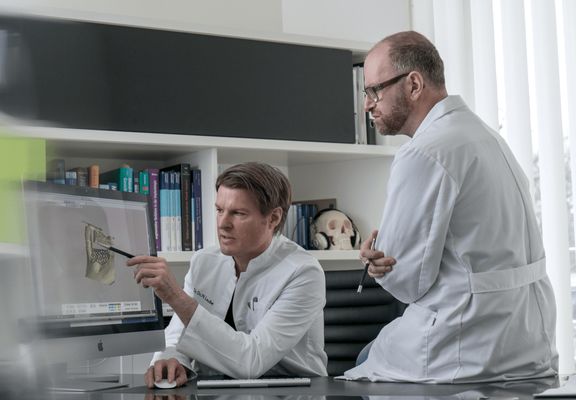
Dental implants are screw-like artificial tooth roots made of titanium or ceramic. They are placed securely in the tooth-bearing part of the jaw and serve as a foundation for crowns, bridges, or dentures. This makes it possible to replace single teeth, multiple teeth, or even the entire set of teeth. Compared with removable dentures, implants offer the unique advantage of restoring teeth and their function so effectively that chewing and speaking feel natural again.
Treatment is often straightforward under local anesthesia. However, it can also be performed under conscious sedation (“twilight sleep”) or general anesthesia.
Choosing dental implants means—with proper care, for which we recommend professional dental cleaning (PDC) twice a year in addition to daily oral hygiene—lifelong enjoyment of fixed teeth and a confident, carefree smile.
What are the advantages of implants over other tooth replacement options?
Implants are an advanced tooth replacement option and offer many key advantages compared to other methods. They are designed as a long-term solution and can last a lifetime, whereas other options such as bridges or dentures often need replacement over time. Implants also provide natural aesthetics and functionality because they are anchored in the jawbone and look and function like natural teeth. Unlike bridges, implants do not require the adjacent teeth to be altered or damaged to support the restoration. In addition, implants can help preserve the jawbone, as chewing forces continue to stimulate the bone. All of these benefits often make implants the best solution for people with missing or damaged teeth.
How long do implants last, and how do you care for them?
Implants are an excellent option for replacing missing teeth. Compared with other tooth replacement solutions, they offer not only aesthetic benefits but also significantly improved function. But how should you care for implants so they last a long time—possibly even for life?
Regular dental check-ups and professional cleanings at least twice a year are essential to keep implants in excellent condition. Good oral hygiene at home is equally important. It is crucial to brush regularly and use dental floss to remove plaque and bacteria, reducing the risk of infections or inflammation. A healthy diet can also help minimize complications and extend the lifespan of implants.
How do the costs of implants compare to other tooth replacement options?
When it comes to tooth replacement, patients have many options—different solutions with different advantages and disadvantages. Implant placement is generally the optimal way to replace missing teeth because it offers a long-term, natural solution. Compared with alternative treatments, implants can be more expensive, as they involve high-quality materials and a more complex procedure. However, they often last much longer—frequently for life—and may therefore be more cost-effective in the long run. At Dentalcentrum Bethanien, we also offer financing options to spread the costs and make implants more affordable. If you want ideal dental restoration without compromise, implants are the perfect choice—even if they are somewhat more costly than other options.
Which factors influence the decision for or against implants?
When assessing whether implants are suitable, various factors must be considered. The jawbone structure plays a key role, since sufficient bone volume is needed to anchor the implant securely. The patient’s overall health must also be taken into account, and potential risks weighed. In some situations, alternative treatments may be more appropriate. For example, in the front (aesthetic) region, a bridge or denture may sometimes deliver a more aesthetic result than an implant. Individual consultation with our dentists and surgeons is therefore essential to find the best solution for each patient.
How do implant success rates compare with other tooth replacement options?
Success rates are an important factor when choosing tooth replacement. Compared with alternatives such as bridges or dentures, implants have a higher success rate. Studies show implant success rates of over 95%, while other options are around 50–70%. This is because implants are firmly anchored in the jawbone, providing a stable base. As a result, they function like natural teeth and feel that way as well. In addition, caring for implants is often easier than caring for other forms of tooth replacement, because they can be cleaned like natural teeth. Implants are therefore not only more aesthetic, but also more functional and longer-lasting than other solutions.
Are implant procedures painful?
A minor surgical procedure to place an implant is usually less stressful than extracting (removing) a tooth. Thanks to local anesthesia, the procedure itself is completely painless. For anxious patients, we also offer treatment under sedation (“twilight sleep”) or general anesthesia. After more extensive procedures, swelling and mild pain can occur. With antibiotics and pain medication as needed, discomfort can usually be kept to a minimum. Any bruising typically resolves within a week. Even after larger procedures, most patients are fully recovered within 7–10 days.
Do implant-supported dentures hold better?
Similar to a crown, a retention element can be screwed onto an implant. These retention elements form a firm connection with the denture and hold it securely and stably in the jaw. If you would like to learn more about the different ways dentures can be anchored with implants, please click one of the links below.
What is the advantage of implants compared to dentures?
The limited stability of dentures is a major restriction for many wearers. The functions our natural teeth provide throughout life can be impaired—or sometimes not possible at all—with dentures.
Eating, a core function of our teeth, is often particularly affected. Many patients cannot eat firm foods with dentures, because this requires fixed teeth and sufficient chewing force. Taste and enjoyment of food can also suffer if the palate is covered by a denture. Taste is influenced not only by taste buds on the tongue, but also by the pressure generated during chewing against the palate. As a result, dentures can lead to reduced enjoyment of eating and—at worst—weight loss, social withdrawal, or reduced quality of life. Another key issue is speech. While traditional dentures that fit poorly can interfere with pronunciation and clear speech, these problems are typically avoided with dental implants.
How high is the risk of losing implants?
Implantology has been intensively researched for about 50 years and therefore has a high success rate. Implants have a survival rate of around 96–98% over more than 10 years, provided risk factors are addressed and good oral hygiene with regular preventive care is maintained. With good care, implants can last a lifetime. Factors that increase the risk of implant loss include smoking, diabetes, untreated severe periodontitis, and challenging anatomical conditions. However, even smokers or patients with periodontitis can achieve very good implant survival rates with good cooperation and care. An individual risk assessment is ideally carried out during a personal consultation.
Do implants have a rejuvenating effect?
The jaw changes shape throughout life. These changes are especially pronounced when teeth are missing. Without teeth, the bone loses its natural stimulation and is broken down by the body—this is known as atrophy.
A severe form is seen in completely edentulous patients. The resulting bone loss (referred to as centrifugal and centripetal atrophy) can lead to a sunken, collapsed midface and lower face, which may look noticeably aged. Colloquially, this appearance is sometimes called a “witch’s face.”
Replacing missing teeth with implants therefore has not only functional benefits, but also an aesthetic, rejuvenating effect.


