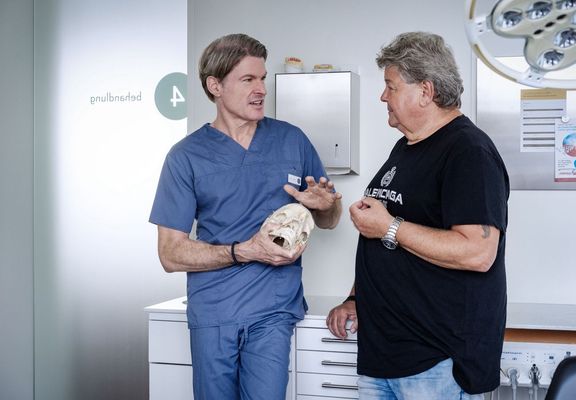
Implants can often be placed without the need for bone augmentation if the anatomical conditions are favourable. In some cases, however, the initial situation requires this preparatory procedure.
In implantology, bone augmentation is a surgical procedure in which the bone in the jaw area is strengthened or rebuilt to create the necessary foundation for successful implant placement. An adequate bone structure is essential for the stability and longevity of dental implants.
There are several techniques available for bone augmentation, including bone grafts and bone block grafts, as well as bone augmentation materials that can be used to improve bone volume when natural bone is insufficient.
Bone augmentation is an important part of implantology, providing the optimal conditions for dental implants to be securely and permanently anchored in the jaw.
What Types of Bone Augmentation Are There?
There are several types of bone augmentation procedures used in implantology to improve bone volume in the jaw. Below, we present some of the most common techniques offered at our clinic.
Sinus Lift
This technique is used when there is insufficient bone in the upper jaw, particularly in the area of the molars (back teeth). During a sinus lift, the sinus cavity is gently elevated and bone material is placed beneath it to ensure implant stability.
In the case of an external bilateral sinus lift, the existing jawbone ridge is too thin for an implant to be placed during the same procedure. In this situation, sufficient bone volume must first be created by lifting the sinus membrane and augmenting it with the patient’s own bone and/or bone substitute material. After a healing period of approximately six months, one or more implants can then be placed in this area.
- Insufficient bone volume and risk of sinus cavity injury
- Elevated sinus membrane (via a surgically created bone window)
- Sinus floor augmented with bone substitute material
- Implant inserted after a healing period of six months
In an external unilateral sinus lift, there is also insufficient vertical bone height in the molar (back teeth) region to place an implant without risking damage to the sinus membrane. In this procedure, a small window is created in the front wall of the sinus cavity, allowing the sinus membrane to be lifted and the area beneath it to be filled with bone or bone substitute material, creating a stable foundation.
Unlike the bilateral approach, the existing bone here provides sufficient primary stability, enabling the bone augmentation and implant placement to be carried out during the same procedure.
Insufficient bone volume with risk of sinus cavity injury
Elevated sinus membrane (via a surgically created bone window)
Sinus membrane augmented with bone substitute material
Implant placed simultaneously during the same procedure.
In an internal sinus lift, the sinus membrane is gently elevated and the cavity beneath it filled through the implant’s drilling channel. This procedure is used when there is insufficient vertical bone height. The sinus floor is carefully lifted using blunt instruments (osteotomes) after each drilling step. While the external sinus lift allows for a greater increase in bone volume, the elevation achieved with the internal technique is typically limited to around 3–4 mm.
Bone Block Transplantation
In this technique, a small block of bone is taken either from another area of the jaw or from a donor source and placed at the site of bone deficiency. This encourages regeneration and improves bone stability, creating a sufficient foundation for implant placement.
Bone Substitute Materials
Various synthetic or biocompatible materials can be used as substitutes for natural bone to stimulate and support bone growth where needed.
Guided Bone Regeneration (GBR)
This technique involves the use of specialised membranes or barriers to promote bone growth in specific areas. It supports controlled healing and helps to create bone volume of adequate size and shape for successful implant placement.
- Resorbed jawbone with insufficient bone volume
- Bone defect filled (using the patient’s own bone and/or bone substitute material)
- Bone defect securely covered with a non-resorbable membrane
- Healed bone defect beneath the membrane
- Sufficient bone volume achieved after membrane removal
The choice of method depends on several factors, including the extent of bone loss, the patient’s individual anatomy, and their treatment goals. During a consultation and after diagnostic assessment, we will recommend the approach best suited to your specific situation.
Does bone augmentation cause pain?
During bone augmentation procedures in implantology, a local anaesthetic is typically used to minimise discomfort during treatment. As a result, patients should not experience pain during the procedure.
After the bone regeneration process, some mild pain or sensitivity in the treated area may occur. These symptoms are generally temporary and can usually be managed effectively with pain medication.
How long does the healing phase take after bone augmentation?
The healing phase following bone augmentation can vary depending on the type of procedure performed. In general, it takes several months for the newly formed bone to become sufficiently strong and stable to support a dental implant. Typically, the healing period after a bone block graft is around four to six months, while for a sinus lift or sinus floor elevation, healing may take around six to nine months.
During this time, the transplanted bone gradually integrates with the existing jawbone as new bone tissue forms. It is essential to follow your surgeon’s post-operative instructions carefully — this includes attending regular check-ups, taking prescribed medication if necessary, and avoiding strain on the treated area. Proper healing is vital for the long-term success of the implant.
What materials are used for bone augmentation?
In implantology, several types of materials can be used to replace missing bone or to regenerate bone tissue. Below are some of the most commonly used materials in bone augmentation procedures:
Autologous bone (patient’s own bone): This type of bone is harvested from another area of the patient’s jaw or body, such as the chin or hip bone. It has the advantage of being biologically active and integrates naturally with the surrounding bone tissue.
Animal-derived bone substitute: The most frequently used bone substitute materials are processed bovine or porcine products (from cattle or pigs). These are sterilised and freed of all organic components, then supplied in varying pore sizes for different indications — typically to repair small to medium-sized bone defects. The healing period usually takes between four and six months, allowing the material to integrate with the patient’s bone. Animal-derived substitutes act as a natural scaffold, guiding new bone formation within the matrix — a process known as osseoconduction.
Patient’s own dental material: In many cases, it is possible to reuse the patient’s own dental substance immediately after a tooth extraction to fill the resulting bone defect and prevent bone resorption during healing. A special sterile single-use device, known as a Dentrigrinder, is used to grind the extracted tooth into fine microparticles. These are then placed back into the socket to help maintain bone volume. Like animal-derived substitutes, this material requires a healing phase of about four to six months before an implant can be placed in the same site. Unlike foreign materials, however, the patient’s own tooth material stimulates the natural formation and transformation of new bone, leaving no residual particles once healing is complete. This process is known as osseoinduction.
Synthetic bone substitute materials:
A variety of synthetic or biodegradable materials can be used as bone substitutes. These include bone graft materials based on hydroxyapatite, tricalcium phosphate, or other bioactive compounds.
Combination materials:
In some cases, combination materials are used, consisting of a mixture of the patient’s own bone and artificial graft materials. This approach combines the benefits of both natural and synthetic substances.
The choice of material for bone augmentation depends on several factors, such as the extent of bone loss and the patient’s individual condition. Before any augmentation procedure is carried out, a thorough examination is performed to determine whether bone grafting is required and to what extent.
Alternatives to Bone Augmentation
Angled implants
Every anatomical situation in implantology is unique. Often, patients present with significant bone loss caused by long-standing tooth loss. A modern innovation in implantology is the use of specially designed implant systems that accommodate existing bone loss through their specific shape and structure, reducing or even eliminating the need for bone grafting.
The so-called implant shoulder — the upper part of the implant — is not straight, as in conventional implants, but angled in such a way that it can align seamlessly with the receded bone.
This design often eliminates the need for preliminary bone augmentation procedures, which would otherwise involve additional time, cost, and physical strain for the patient. By using an angled implant, treatment can proceed more efficiently and with less overall intervention.
The stability, longevity, and functional load-bearing capacity of such implants are equivalent to those of conventional implants. Therefore, under suitable anatomical conditions, angled implants can be the ideal choice for achieving optimal functional and aesthetic outcomes.


