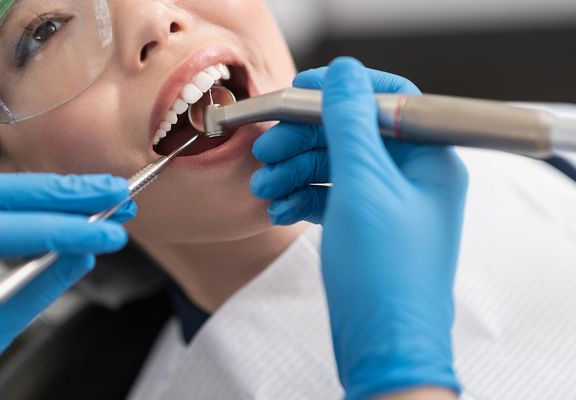
Tooth preservation and replacement play a crucial role in maintaining oral health, quality of life, and overall wellbeing. Through regular dental check-ups, conditions or other issues can be detected early, helping to prevent damage to the teeth and supporting structures before they occur.
In cases of actual or potential tooth loss, the range of treatments for preserving natural teeth and providing restorations is as varied as our patients’ individual situations. Treatment options extend from composite fillings and inlays (ceramic or gold) to tooth-coloured crowns and bridges, as well as partial and full dentures. We place particular importance on the advantages of all-ceramic restorations crafted in our specialised dental laboratories – so you can smile with confidence again!
What can be done about damage to the tooth enamel?
For teeth with small cavities or minor defects, we generally use high-quality composite resin. This cost-effective treatment can preserve the affected teeth for several years, and the materials used are virtually indistinguishable from natural teeth.
When larger areas of a tooth are affected, stabilising the remaining tooth structure becomes necessary. For this purpose, we offer all-ceramic inlays, crowns, and bridges that are custom-made for each patient. These restorations are extremely durable, precisely fitted, and resistant to deformation. Once placed, they are indistinguishable from a natural tooth. Modern ceramics have the same hardness as natural enamel and are exceptionally strong and long-lasting.
What exactly does “dental restoration” mean?
Fixed dental restorations are supported by natural teeth or implants and are permanently placed in the mouth. The patient cannot remove them independently. Fixed restorations include crowns and bridges — in the case of bridges, neighbouring teeth are shaped to act as anchors.
Removable dental restorations, on the other hand, are supported by teeth, implants, or a combination of both and rest on the soft tissues of the mouth. They are held in place by clasps, double crowns, or precision attachments. These include full and partial dentures, which patients can remove themselves for cleaning and then reinsert.
Dentures consist of a gum-coloured acrylic base and a (partial) set of acrylic teeth. They rest directly on the oral mucosa and are held in place by suction and the natural muscles of the mouth.
To improve the stability and fit of dentures, implants can also be placed in addition to any remaining natural teeth. Depending on the number of implants used, this creates a solid foundation, allowing for a palate-free, lighter, and more elegant denture design. This enhances taste perception, improves denture stability, and increases chewing efficiency and comfort.
For patients who have lost all their teeth, a horseshoe-shaped bridge can be permanently fixed to the jaw if a sufficient number of implants are available. This creates a natural feeling in the mouth and significantly improves quality of life. In many cases, a temporary version of this restoration can be fitted immediately after implant placement, avoiding the need for a removable full denture.
How can I keep my teeth healthy for life?
The foundation of good oral hygiene begins at home. This includes choosing the right toothbrush with suitable bristles and using a fluoride-containing toothpaste. Dental floss and interdental brushes should also be used daily, as regular brushing alone cannot reach the spaces between teeth.
In addition to these daily habits, regular dental check-ups are essential. Many conditions such as tooth decay or gum disease (for example, periodontitis) can progress silently and painlessly over time and may only be detected through professional dental examinations.
What treatment options are available for major tooth damage?
For more extensive tooth damage – such as after decay – we perform a filling treatment once the harmful bacteria have been removed. The highest-quality material is ceramic, though composite fillings made from resin are also used. Depending on the extent of the damage, teeth may also be partially or fully crowned, with materials such as gold or ceramic.
Should prematurely lost baby teeth be replaced?
This depends on the situation. If a baby tooth is lost early due to an accident or decay, the gap should generally be closed to prevent problems with speech development or jaw growth. However, if imaging shows that the permanent tooth will soon erupt, replacement is usually unnecessary. The situation differs if, in certain areas of the mouth, no permanent successor tooth exists.
What types of removable dental restorations exist?
Removable dental restorations include partial and full dentures, as well as constructions attached to neighbouring teeth using clasps. There are also combined restorations that feature both fixed and removable components, such as attachment or telescopic dentures. Implants or mini-implants with snap-on full dentures also belong to this category.
What types of fixed dental restorations exist?
Fixed restorations typically include bridges that are cemented onto previously prepared abutment teeth to close the gap. The range of options is broad. The most advanced solution involves implants anchored in the jawbone, serving as stable supports for bridge structures that are screwed onto them.
What are the advantages of fixed versus removable restorations?
Fixed restorations provide a stable, permanent solution securely anchored in the mouth, offering a natural look and chewing function.
Removable restorations, on the other hand, offer easier cleaning and maintenance since they can be taken out. They can also be more easily adjusted or repaired if needed.
Can I receive dental restorations if I suffer from gingivitis or periodontitis?
No, especially fixed restorations should only be placed when the mouth is completely healthy. We are happy to work with you to select the most suitable treatment steps to effectively combat gum inflammation and create the right conditions for dental restorations.
My removable full denture slips – is there a solution for this?
First, the cause of the slipping should be analysed to determine whether the denture’s current fit is suboptimal. In some cases, implants can provide an effective solution. These allow the denture to be stabilised with a type of snap-button system that offers excellent grip on the gums. Often, the existing denture only requires adaptation to this system. Any pressure spots can also be adjusted to ensure a secure and comfortable fit.
Can I receive implants if I have diabetes?
This must be assessed individually. If your medication is well-regulated, treatment with implants and/or mini-implants is often entirely possible.
Do tooth gaps always need to be closed?
Yes, as otherwise teeth may shift within the jaw, with neighbouring teeth tilting into the gap. This can also lead to changes in the bite, and the bone beneath the gap gradually recedes (atrophy). The only exception is when a baby tooth is lost prematurely — in such cases, the gap can remain temporarily, but only until the permanent tooth erupts and naturally closes it.
I have complete tooth loss – what is recommended?
In cases of complete tooth loss, a full denture can be used. However, since these often fall short of patients’ expectations in terms of aesthetics and comfort, we recommend placing implants beforehand to provide a more stable foundation. Another alternative would be bridge constructions that are securely screwed onto previously placed implants.
Can I receive dental restorations even with limited bone structure?
Removable restorations, as well as bridges and crowns, can often be fitted regardless of how much bone is available. Implants can also be placed in areas with reduced bone under certain conditions. If the bone foundation is insufficient to anchor implants and connect them later to bridges or dentures, there are several options to rebuild adequate bone volume. We are happy to discuss these possibilities with you in a personal consultation.
What financial support is provided by health insurance?
Dental restorations include inlays, crowns, bridges, and removable dentures. The determining factor for financial assistance is always the treatment and cost plan prepared by your dentist, which is then submitted to your health insurance provider. Typically, health insurance covers up to 50% of the treatment cost — or up to 65% if you have a fully maintained bonus booklet.
Your personal contribution may be further reduced if the cost of the restoration would otherwise represent an unreasonable financial burden, depending on your income level. In general, the reimbursement amount depends on the diagnosis rather than the chosen type of restoration — for instance, opting for implants instead of a removable full denture will not automatically result in higher coverage. In such cases, supplementary dental insurance taken out in good time can be highly beneficial.


