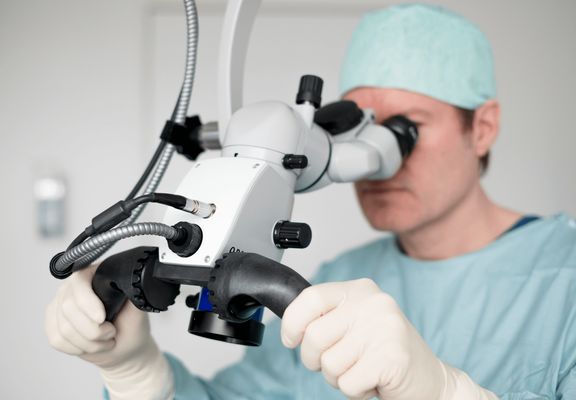
Inflammation in the area of the tooth roots can be extremely painful. Treating the root is essential to prevent harmful bacteria from spreading through the body and to relieve the patient’s pain. In the field of endodontics – a specialist branch of dentistry dealing with diseases of the dental nerves, the dental pulp, and the dentine – modern techniques have made root canal treatments increasingly successful. Our goal is always to preserve as much of the natural tooth structure as possible while ensuring that you can smile comfortably again soon. Should any tooth discolouration occur after treatment, we can advise you on internal bleaching options.
How does a root infection develop?
A root infection is usually caused by tooth decay or trauma. When bacteria or injury lead to the death of the dental nerve, an inflammatory reaction occurs in the surrounding bone. Once bacteria reach the root canal, abscesses often form. The pain caused by an inflamed tooth root can be intense and should never be underestimated. A gentle root canal treatment is the best way to eliminate the bacteria. Thanks to highly precise instruments and strict hygiene standards, such treatments are now more successful than ever. At our practice, we use a mechanical procedure with high-quality single-use files and determine the exact length of the nerve canal electronically. Finally, we clean and disinfect the canal according to a defined irrigation protocol, which significantly increases both the success rate and the chances of preserving the tooth.
What happens during a root canal treatment?
We provide high-quality, precision root canal care. Using an advanced mechanical system, the canals are prepared to the exact length with sterile single-use instruments. They are then thoroughly flushed and disinfected using ultrasound. A dental dam (rubber dam) is applied to keep the treated area as germ-free as possible. In addition, photodynamic therapy is used to eliminate remaining bacteria and further improve the outcome.
The mechanical treatment of root canals has shown significantly improved outcomes compared to purely manual procedures. Another major advantage is that it often requires considerably less treatment time.
During a root canal treatment, the inflamed root canals are carefully widened using very fine instruments, extending all the way to the tip of the root. Between steps, the canals are flushed and disinfected with various irrigation solutions. This process gently removes harmful bacteria and inflamed tissue from the affected area. The cleaned canals are then filled with a thermoplastic material to create a bacteria-tight seal. Finally, the tooth is permanently closed.
How long does a root canal treatment take?
The duration of a root canal treatment cannot be determined precisely, as it depends on several factors. As a general guideline, around one hour per canal can be expected. However, the actual treatment time varies depending on the extent of the inflammation, the curvature of the root, and how many branches the root canal system has.
Will I feel pain after the treatment?
Pain caused by inflammation usually subsides quickly once the bacteria have been removed. The body typically needs up to two days to adjust. If necessary, we can prescribe mild painkillers for this period. Applying a cool compress can also help relieve any remaining discomfort.
How long does healing take, and when can I return to work?
If there is an acute infection, you should rest on the day of the procedure. In rare cases, taking an additional day off may be advisable. The recovery time depends on the severity of the infection. If the jawbone has been affected, healing will take longer than if only the tooth roots were inflamed. In most cases, you will be able to bite down normally again within a short time.
What happens to a “dead” tooth?
After a root canal treatment, the tooth is no longer supplied with blood or nerve signals. Nevertheless, this is a far better option than extraction. Preserving the natural tooth structure is always the top priority. Following treatment, the tooth is typically restored with a crown, allowing it to continue functioning normally. Because chewing forces are still transmitted to the jawbone, the bone remains active and does not recede.
Can I prevent a root infection?
Yes, because root infections are caused by harmful bacteria. If you brush your teeth and clean between them regularly and properly, visit the dentist twice a year for check-ups, and have professional teeth cleaning carried out on a regular basis, you are generally well protected. In addition to preventive care, it is important to visit our practice promptly if you notice any irregularities and not to put off seeing the dentist.
How can I recognise an infection?
A root infection typically presents with pain and a feeling of pressure around the affected tooth, or it may be detected during a routine check-up on an X-ray or through changes in the gums.
My tooth has become discoloured after root canal treatment – what can be done?
As part of aesthetic dentistry, it is possible to carry out what is known as internal bleaching on front teeth. A special bleaching agent is placed inside the tooth, which lightens its appearance so that it blends in better with the surrounding teeth. If the whitening does not achieve the desired result, the tooth can alternatively be restored with ceramic materials such as veneers.


